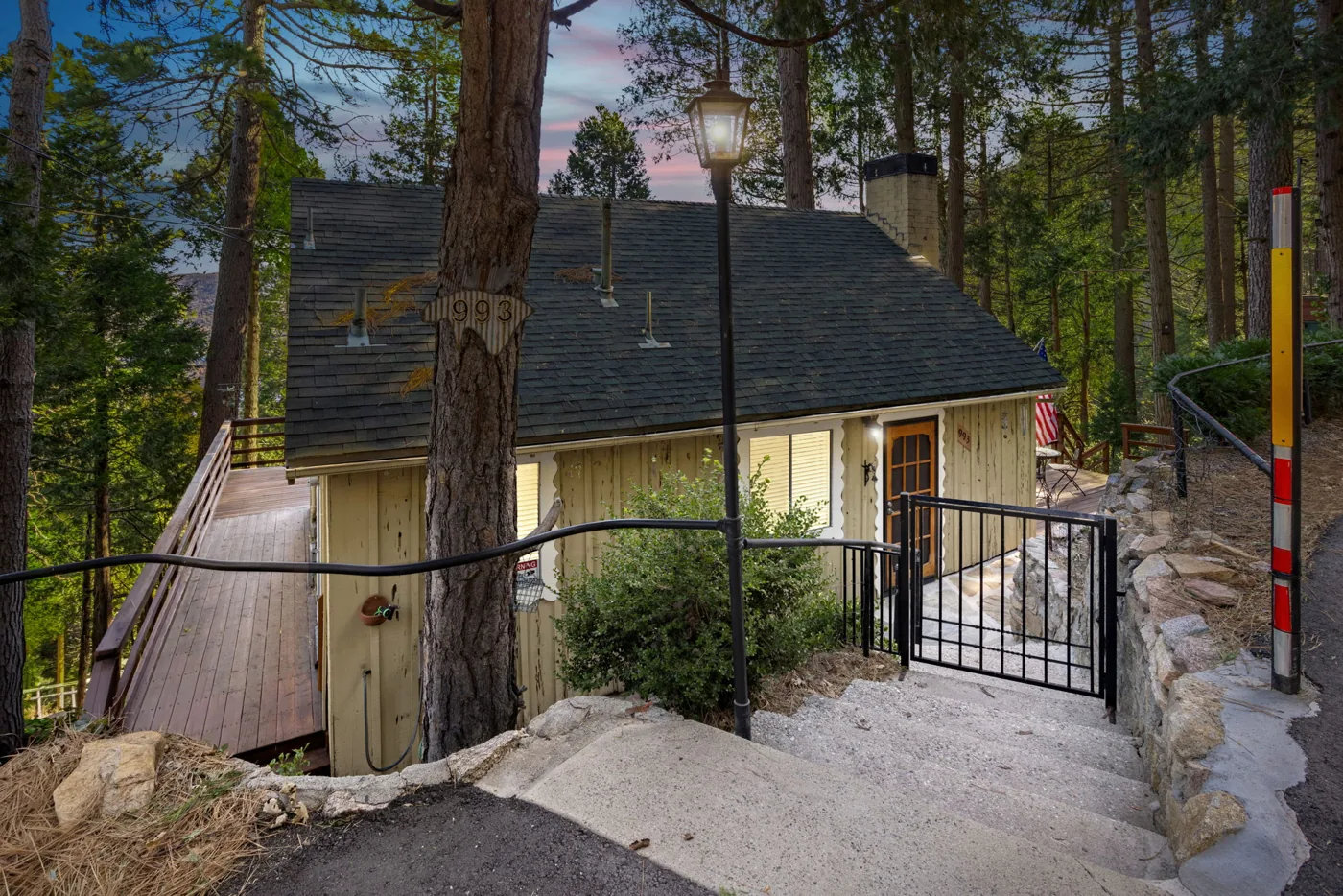
Easton v. Strassburger (1984) 152 Cal.App.3d 90 is the California appeals court case that made home-selling brokers responsible for what a careful look at a property would reveal. In 1985 the Legislature turned that idea into Civil Code § 2079, which requires a visual inspection by agents on most home sales. The AVID form many agents use today grew out of that rule. None of it replaces a professional home inspection.
This article explains the history in plain terms. It is general information, not legal advice. For a question about your own sale or purchase, talk to a California real estate attorney.
What happened in Easton v. Strassburger?
According to the court's opinion, the property was a one-acre parcel in Diablo with a roughly 3,000-square-foot house, a pool and a large guest house. Diablo is an unincorporated community in Contra Costa County. The buyer paid $170,000, and escrow closed in 1976.
Soon after the sale, the ground moved. More slides in 1977 or 1978 destroyed part of the driveway. Experts testified that part of the lot sat on fill that had not been properly engineered or compacted. The house settled, and walls cracked and doorways warped.
The court described these numbers from the trial:
- Undamaged value: about $170,000.
- Damaged value: as low as $20,000.
- Repair estimates: up to $213,000.
What the listing agents saw
The sellers had a minor slide in 1973 and a major one in 1975. The opinion says they did not tell their agents about either slide or the repairs.
The two listing agents visited the property several times. The court found evidence that they noticed warning signs of soil trouble:
- They knew the house was built on fill, which is often linked to settling.
- They saw netting on a slope, installed to repair the latest slide.
- One agent saw that a guest house floor was not level. The other testified that uneven floors can signal soil problems.
The agents did not ask for soil testing and did not warn the buyer.
The verdict and how fault was split
The buyer sued the sellers, the listing brokerage and three builders. She had voluntarily dismissed her fraud claims against the brokerage, so only negligence theories reached the jury on that defendant. The jury awarded $197,000 and split fault this way, per the opinion:
| Party | Share of fault |
|---|---|
| Sellers | 65% |
| A builder and a building company | 15% |
| Another builder | 10% |
| Listing brokerage | 5% |
| Cooperating broker (not a party) | 5% |
The brokerage was the only party to appeal. The First District Court of Appeal ruled on February 22, 1984. A 2024 Contra Costa Lawyer article by attorney Karl E. Geier reports that the California Supreme Court declined to review the case that same year.
What did the court decide?
The court upheld the negligence verdict against the brokerage. It held that a seller's broker in a home sale has a duty "to conduct a reasonably competent and diligent inspection of the residential property listed for sale" (Easton opinion). The broker must then disclose what that inspection would reveal.
The court also set limits. It took no position on commercial sales. It said buyers must still look out for themselves with reasonable care. And if a flaw is plain to see, a broker may not be negligent for staying quiet about it, because the buyer's own look should have caught it.
How did California's Legislature respond in 1985?
The Legislature passed SB 453 in 1985 to spell out the duties of brokers and buyers, according to a Senate Judiciary Committee analysis. The new rules are in Civil Code §§ 2079 to 2079.6.
Civil Code § 2079: the visual inspection duty
Section 2079 requires a licensed broker or salesperson to do a reasonably competent and diligent visual inspection. Agents must disclose the material facts that inspection would reveal. Today it covers residential property with one to four units and manufactured homes.
The statute adds the word "visual" to the duty the court described. It covers the listing broker. It also covers a broker who cooperates with the listing broker to find a buyer, per the statute text. The disclosure guide from the California Department of Real Estate (DRE) says the duty falls on both the listing agent and the selling agent, separately.
The latest change came from AB 892 (Stats. 2019, ch. 310), effective January 1, 2020. It switched the scope from single-family property to homes with one to four units.
Section 2079.3: what the inspection does not cover
Under § 2079.3, the agent does not have to inspect:
- Areas that are not reasonably and normally accessible.
- Areas off the property.
- Public records or permits about title or use.
- In a condo, planned development or co-op, anything beyond the unit for sale, as long as the required HOA documents are provided.
These limits are about the walk-through only. The Easton opinion notes that California law already required a seller's broker to disclose known material defects that the buyer could not see.
Section 2079.5: the buyer's duty
Section 2079.5, also added in 1985, says the agent rules do not excuse buyers. You must use reasonable care to protect yourself. That includes facts you know and facts that careful observation would turn up.
Section 2079.4 also limits how long a buyer has to sue for a breach of the inspection duty. The limit is two years, counted from the earliest of recording, close of escrow or occupancy.
How did this lead to the AVID form?
The Agent Visual Inspection Disclosure, or AVID, is a form from the California Association of REALTORS (C.A.R.). A 2020 California Lawyers Association article explains that the trade group developed it as a tool for agents' disclosure work. In practice, it gives an agent a place to note what they saw in each part of the home.
No law requires this particular form. A firsttuesday Journal article calls it non-mandated. The legal duty is the inspection and the disclosure, however an agent documents them.
Because the DRE says each agent has the duty, one agent's walk-through does not stand in for the other's. We do not reproduce the form here. Ask your agent for a copy of any visual inspection disclosure completed on the home.
How is the agent's disclosure different from the seller's TDS?
The Real Estate Transfer Disclosure Statement (TDS) comes from Civil Code § 1102 and the sections after it. Section 1102 says any waiver of these disclosure rules is void. The 2024 Contra Costa Lawyer article traces the TDS to the same 1985 reform wave.
The two disclosures come from different people:
- The seller fills out the main TDS sections about the home's condition, based on what the seller knows. The DRE guide notes those statements are the seller's, not the agents'.
- The agents add their own sections. The listing agent reports on the seller inquiry and the visual inspection. The agent who obtained the offer, if different, adds a separate section.
The firsttuesday article notes that C.A.R. describes the AVID as giving agents more space than the TDS agent sections, with room-by-room prompts.
What does this mean for buyers and sellers today?
If you are buying, treat agent disclosures as a starting point. An agent looks only at what is easy to see. Agents do not test soil, open walls or check permits. The DRE's guide notes the TDS is not a substitute for inspections. Hire a licensed home inspector, and add specialists such as a roofer, pest inspector or geotechnical engineer when something looks off. Your contract sets the time you have to do this. Our guide to how escrow works in California explains those contingency periods.
If you are selling, the agent's inspection does not replace your own disclosures. You still must disclose what you know. In Easton, the jury put most of the fault on the sellers who knew about past slides.
On the High Desert, the same state rules apply to homes in Hesperia as in Diablo. Ask early about grading, drainage and any past repairs.
How Pleasant Hill can help
Questions about disclosures on a home you are buying or selling? You can search homes, request a free home valuation or contact us. In Hesperia, reach Nancy Navarro or broker Dustin Bynum.
Share this guide
Frequently asked questions
What is the citation for Easton v. Strassburger?
Easton v. Strassburger (1984) 152 Cal.App.3d 90, 199 Cal.Rptr. 383. The First District Court of Appeal decided it on February 22, 1984.
Does a California agent's visual inspection replace a home inspection?
No. The agent's duty under Civil Code § 2079 is a visual walk-through of reasonably accessible areas. It is not a professional inspection, and the law still expects buyers to use reasonable care to protect themselves.
Do both the listing agent and the buyer's agent have to inspect?
Yes. The California Department of Real Estate's disclosure guide says the listing agent and the selling agent on a one-to-four unit home each owe the visual inspection duty. The statute covers the listing broker and any broker who cooperates with that broker to find a buyer.
Is the AVID form required by law?
No statute requires that particular form. The law requires the inspection and disclosure; the AVID is a form the California Association of REALTORS created to help agents document it.
How long does a buyer have to sue over a missed visual inspection disclosure?
Civil Code § 2079.4 sets an outer limit of two years. The clock starts at the earliest of recording, close of escrow or occupancy. Talk to a California real estate attorney about your own situation.
Sources
- Easton v. Strassburger (1984) 152 Cal.App.3d 90 (Justia) (accessed November 2, 2026)
- California Civil Code § 2079 (California Legislative Information) (accessed November 2, 2026)
- California Civil Code § 2079.5 (California Legislative Information) (accessed November 2, 2026)
- AB 892 (2019), Statutes 2019, Chapter 310 — bill text (LegiScan) (accessed November 2, 2026)
- Senate Judiciary Committee analysis of AB 1750 (2016) (accessed November 2, 2026)
- Disclosures in Real Property Transactions, 6th ed. (California Department of Real Estate) (accessed November 2, 2026)
- Diablo (Contra Costa County) (accessed November 2, 2026)
- Civil Code § 2079 text (California Public Law) (accessed November 2, 2026)
- Civil Code § 2079.3 text (California Public Law) (accessed November 2, 2026)
- Civil Code § 2079.4 text (California Public Law) (accessed November 2, 2026)
- Civil Code § 1102 text (California Public Law) (accessed November 2, 2026)
- Easton v. Strassburger: A 40 Year Legacy, Contra Costa Lawyer, Sept. 2024 (Contra Costa County Bar Association) (accessed November 2, 2026)
- Can a Broker Avoid Its Duty to Physically Inspect the Property? (California Lawyers Association, 2020) (accessed November 2, 2026)
- The redundancy of the Agent Visual Inspection Disclosure (firsttuesday Journal, 2020) (accessed November 2, 2026)
General information, not legal, tax or lending advice. Rules, fees and rates change; confirm with the agency linked above or ask us. Pleasant Hill Real Estate Group · CA DRE Corp. #01997374 · AZ Entity Lic. #LC694532000 · Equal Housing Opportunity.